Wednesday, December 16, 2015

With two days left, Canada is still part of the problem in Paris

PARIS — Although it’s been reported in the Canadian media that China and India are blocking progress at COP21, the biggest obstacle appears to be the unwillingness of the developed countries to talk about historical responsibility and reparations. Earlier this week, Canada was a co-winner of the Fossil of the Day award, as climate activists expressed their dismay at this stance. Canadians are some of the worst climate polluters, per capita, in the world, and our current (and projected future) pollution through plundering the tar sands, means that we’re not getting any better.

Canada industrialized early, and it has been emitting carbon pollution for well over a hundred years, giving it a significant “head start” over India, China, and other less developed nations. Yet the Canadian negotiators don’t want to acknowledge this, much less pay our debts.

Admittedly, it’s not just Canadian negotiators who are trying to hide this great injustice. The U.S., along with many of the other countries that industrialized (and polluted) early have had a multi-year agenda to remove acknowledgement (and responsibility) of this injustice from the COP negotiations. They have largely been successful in doing so.

The negotiators at COP are not on an equal footing. Many of the negotiators from the Global South are trying to avoid climate devastation in their countries and climate genocide of their peoples. On the other hand, the negotiators of developed nations are generally trying to keep a fossil-fueled power system in place, rather than consider other necessary options. Last week Canadian youth joined others from around the world to highlight this imbalance.

Photo credit: Sierra Student Coalition

Since pre-industrial times, the burning of fossil fuels has raised the global temperature by 1C. Even with this “modest” increase, we are seeing a rise in climate chaos around the world, with climate destruction like the floods currently devastating Chennai, India. We’re also seeing an increase in climate-spurred wars. The current war in Syria is set in a context of severe drought worsened by climate change: in one agriculture-dependant area of the country, 75 per cent of farmers experienced total crop failure in 2007-2008. About 1.5 million people fled the starving countryside and crowded into the cities — imagine the populations of Brampton and Mississauga moving into Toronto, or everyone in Ottawa-Gatineau squeezing into Montreal. Subject to war and instability, this kind of desperation provides a breeding ground for climate-driven terrorism. The violence of climate change takes many forms.

In order to avoid a dangerous climate breakdown, countries agreed in 2009 that we must avoid a 2C global rise in global temperatures. Even this is a significant planetary risk (and will result in the deaths of many millions of people) — the Canadian youth delegation, along with many scientists and the countries most affected by climate violence, are calling for “1.5 to stay alive.”

But the political systems of the countries of the world are failing miserably at achieving this, putting emission reduction offers on the table that would result in temperature increases in the 2.7C to 3.5C range. Realistically, we can expect these political systems to fail to deliver on their promises, putting us back into the “unlivable for human life” 4C to 6C range.

With such high stakes, you might expect the Canadian negotiators to be working hard to give us a healthy climate future. Sadly, our Canadian negotiators are not working to protect the health of Canadians and people around the world. Instead, they’re trying to ensure that big polluters, such as the tar sands extractors, can continue to pollute and cause ever more societal instability and fragility. Instead of trying to create a rapid transition to a fairer, richer Canada, they’re negotiating which decade we’ll go extinct.

Although Trudeau has promised “real change,” it’s clear that we need far more change than he has delivered thus far. The real change required by science must include a freezing of the tar sands and a rapid, nationwide transition to renewables. Real change must include negotiating a path at COP21 towards a healthy future for all, with ambitious targets, binding commitments and payment of our climate debts. Real change must include actual change, yet so far Trudeau seems to be peddling words, not deeds.

Keeping climate change below 1.5C means no more pipelines, and a freeze on tar sands expansion. Trudeau needs to make a choice between the oil industry and the planet, but thus far he seems to think he can be a climate hero while also continuing to build tar sands infrastructure.

It’s time to pick a side.

This was originally posted on Ricochet.

Tear Gas Taste and Pepper Spray Pain

I arrived in France on Nov 23rd and spent the first week visiting with some friends in Meaux, the home of Brie. It’s was a pretty chill week, adapting to jet lag (which I made soooo much worse by partying until 5am in Reykjavik), brushing up on French, and enjoying the company of my friends.

On Sunday Nov 29th I moved to my next ‘home’ in downtown Paris. I dropped off my stuff and shot out the door to join the now-illegal march at Place de la Republique. The march was illegal because the French state had used the “opportunity” of the murderous attacks on 13th Nov to institute a ban on political public gatherings of more than two people! Along with this ban came a host of fascist-like police powers, which the police quickly abused by terrorizing the innocent Muslim community with thousands of home invasions, as well as attacking dozens of climate activists.

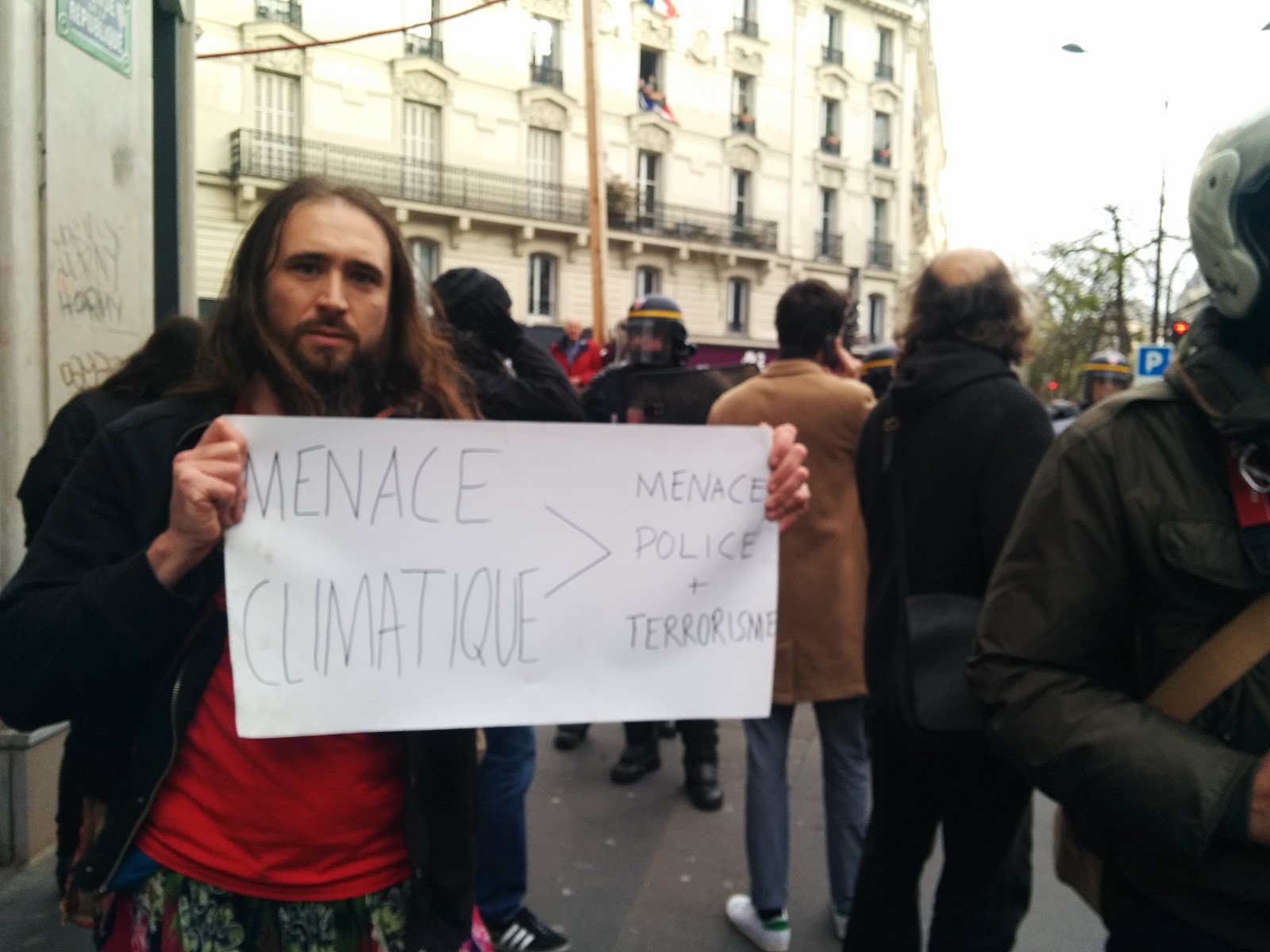
Instead of a 400,000-person climate march, NGO’s had retreated from this state repression (a tactical mistake) and canceled the ‘official’ march, instead trying to give people alternative outlets on the 29th. I missed the “human chain”, and only saw the “march for me shoes”—a sad reminder of state oppression—as they were packed away. Over the next couple of hours I wandered round the public square, talked with a few people, made a sign (“Menace Climatique > Menace Police + Terrorisme”) and joined the short-lived, smaller “marches” that local organizers spurred into existence. These grew and grew, and shortly after 2pm the march was big enough for us to leave the square. We headed down Avenue de la Republique.


We didn’t make it far. A wall of police waited for us, armed to the teeth and itching to start pepper spraying us. I was close to the front (you can see how close in the picture above) and held up my sign to the police, so that they knew why I—and I suspect others—were marching. A few swells of courage and chanting from the protesters, and the police unleashed. It was in those moments that I first felt the pain of pepper spray, although I have not yet been sprayed directly.

After most of the crowd had retreated, a few of us remained. Some lay down, and a girl sang. I kneeled in front of the police with my sign, petrified that I’d receive a blow from behind at any moment, yet it never came. Once a hundred photos had been taken by dozens of the press, I stood back up and walked back into the public square.


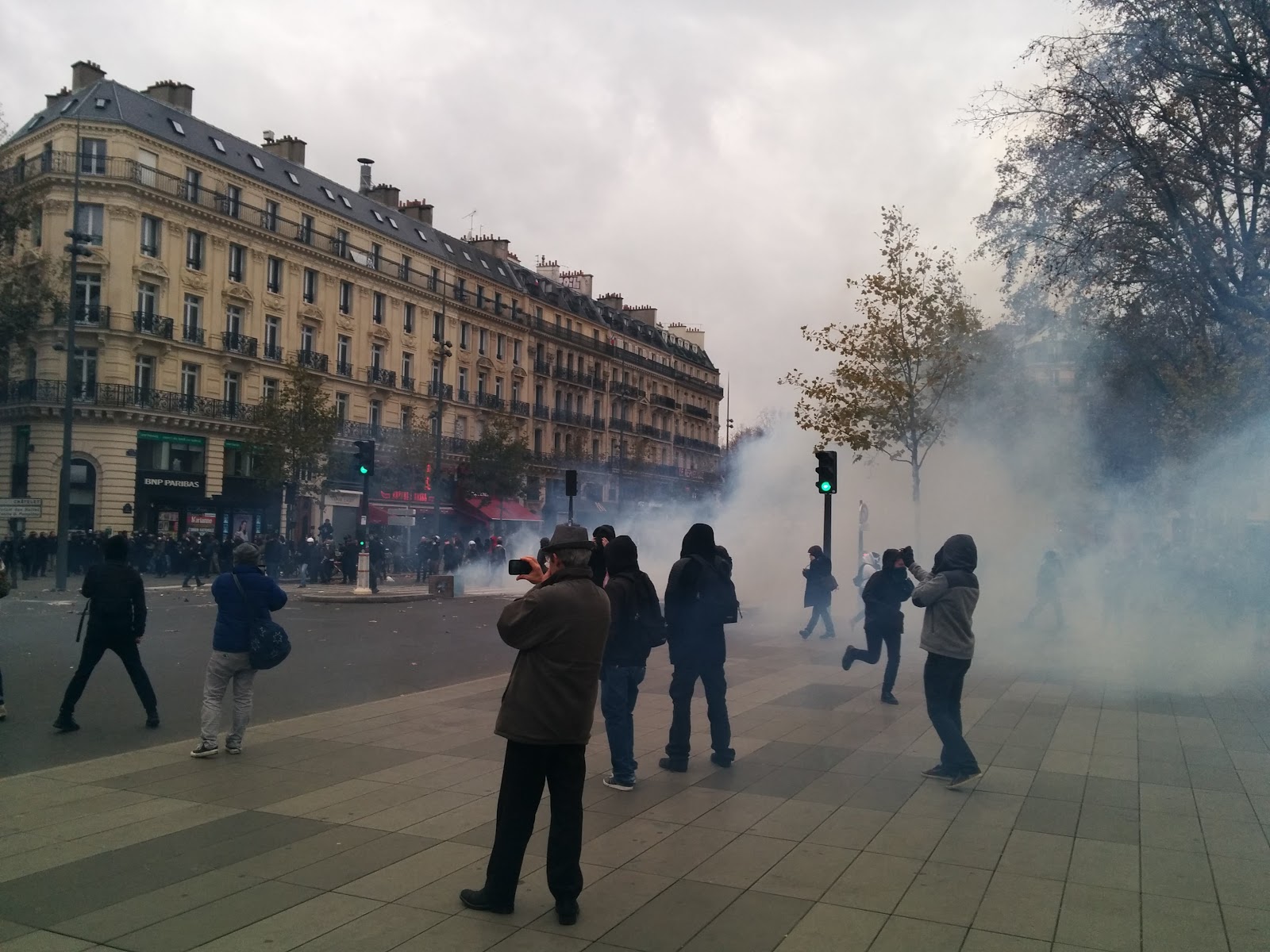
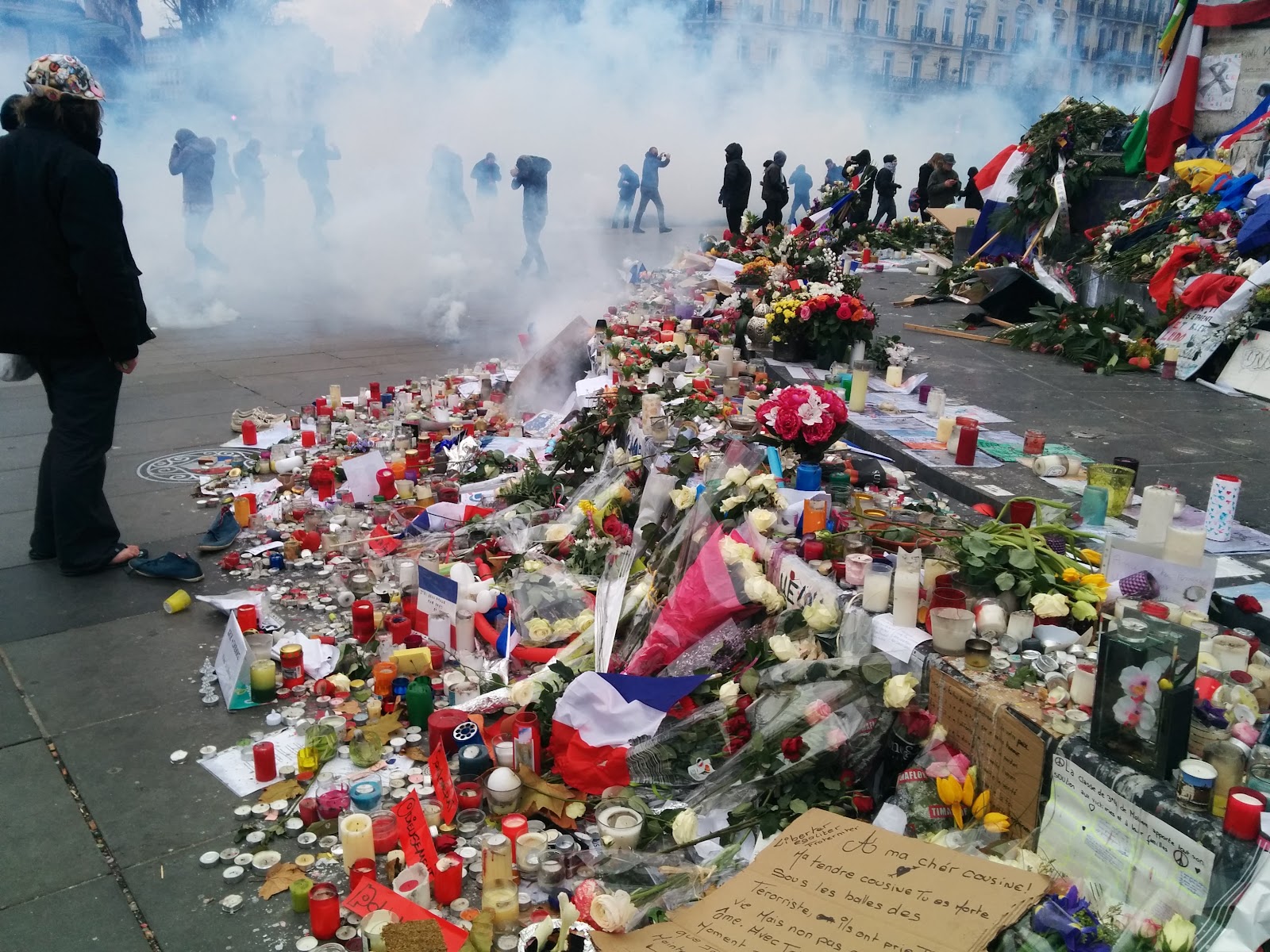
It was a scene of chaos. Groups of people were around the square, and at the far end I saw dense clouds of tear gas. I hurried over, wanting to document what I was witnessing. As small groups of young people threw what little they had at heavily armoured police lines, police were attacking with overwhelming force. They shot cluster-bomb fireworks into the air, which split into half a dozen tear-gas-spewing canisters, turning huge areas of the public square into toxic zones of pain. People from many walks of life were caught in the debilitating gas—not just the protesters close to the police, but also tourists, children, and protesters who were trying to avoid police presence entirely.


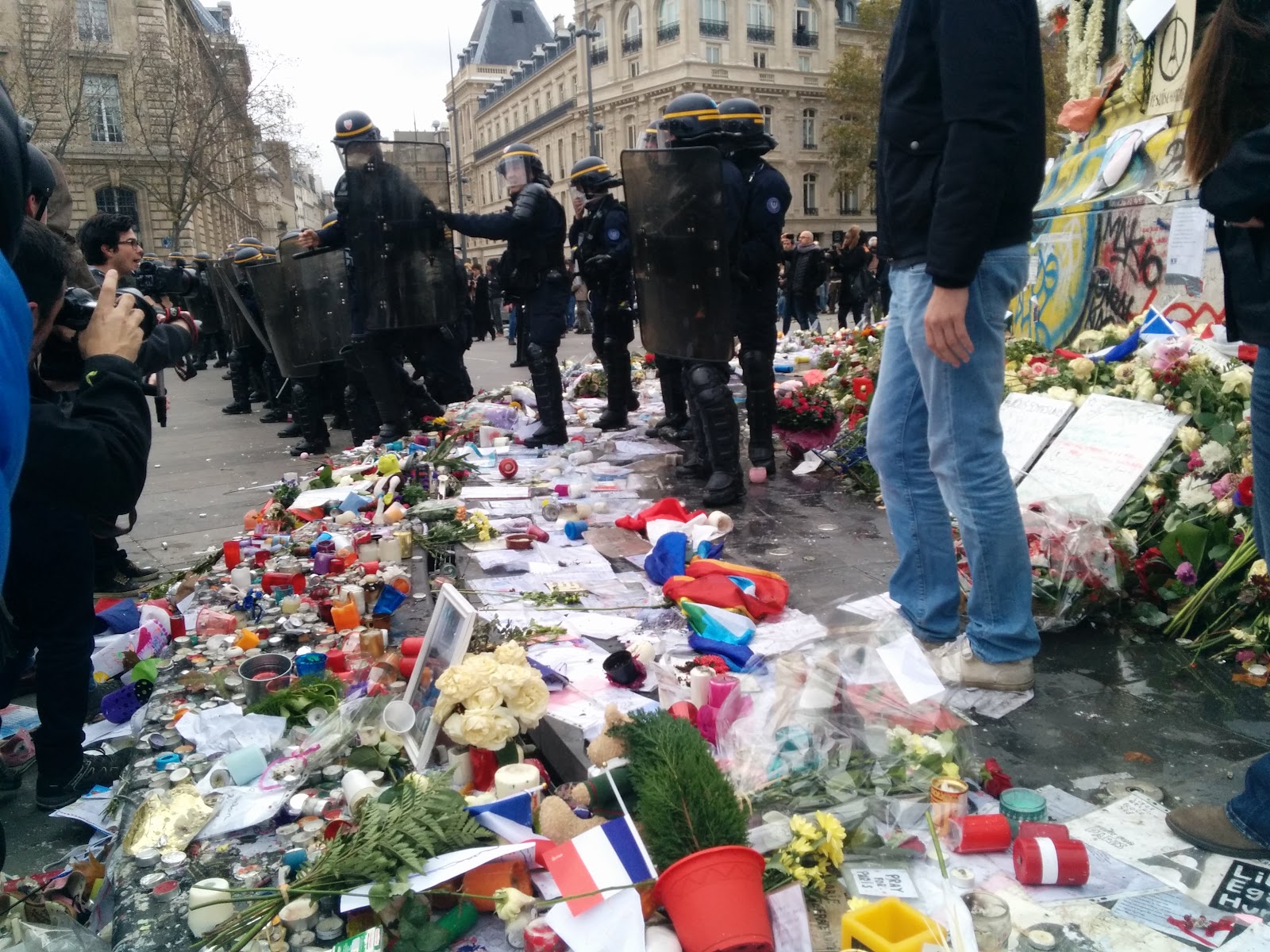
Over the next couple of hours the police closed in (trampling on the flowers and candles that had been left for those killed on the 13th), eventually kettling (trapping) several hundred of us against a building, where they held us for three hours. I tried speaking with some of the protesters around me, but my limited French caused connection problems, and although they were nice, I felt pretty alone. In those moment I was very glad to have support of a friend who was outside the police lines, chatting away with me on my phone. There was also a bike trailer with a speaker, so we put some music on and had a rave in the street. Dancing helped to keep our spirits up.


Eventually the police came for us. Batons in hand, they roughly grabbed us a few at a time and ripped us apart from our fellow protesters with whom we’d linked arms. Sometimes they failed to get any of us, sometimes they succeeded. A couple of times (that I witnessed) they came in with their batons swinging, and it would surprise me if no bones were broken that day. It was harrowing to see the glee with which the police attacked us, having already dehumanized us and justified their tyranny as “just doing my job”.

Eventually I too was taken. A single police officer led me out, though he instantly softened when I said I was Canadian. He wasn’t looking to arrest me, but many arrests did happen that day—likely French climate activist that they’d had their sights on for some time (quite why the police seem to overly target climate activists is another matter). He gave me the choice of getting on the police bus (a tempting offer, to stand in solidarity with those who were being arrested), but I chose the other option: to walk away and head home to sleep—a privilege I am lucky to have.

Photo credit: Stu Basden

Thursday, November 26, 2015

Connect the Refugee Climate Dots

About three years ago, climate groups ran a campaign to help people connect-the-dots between climate change and extreme weather disasters.[1] At the time, this image became etched into my mind:


High school Students connect the dots on climate change near Dallas, Texas in 2012. (Photo: 350.org)

Three years later, there is no question in people’s mind that the increasing devastation from extreme weather disasters are closely linked to our worsening climate. Today, there’s another set of dots that we need to connect: the dots between climate, racism, refugees and immigration.

I’m not the first to be saying this, by a long stretch. However, it hasn’t yet sunk in for many people the way the weather disasters have. Nevertheless, these dots are all connected.

Just as the Tahir Square uprising in Egypt was set against a backdrop of drought and high grain prices, the degenerative violence in Syria has a backdrop of a climate-change-fueled eight year drought, with 75% of farmers suffering total crop failure.[2] This drought forced many to flee the starving countryside to make for the cities, causing the pressure build up to bursting. The ensuring war is a result. The millions of refugees then followed.

These people are climate refugees.

We need to make these connections, understanding that caring about climate change means we also need to care for those who suffer from it now. Let’s review a few more dots...

In the past week I’ve seen a horrifying number of attacks on Muslim peoples (and people mistaken for being Muslim) in Toronto. There’s been at least 3 cases that made it into the media,[3] and likely many more that didn’t. Given Toronto is the most diverse country in the world, these attacks are even more chilling (tho this story warmed my heart a little). And this is just scratching the global dotty surface.

We’re seeing the rise of neo-Nazi groups across Europe, such as a Golden Dawn, who are increasingly attacking climate refugees and immigrants.[4] In Paris last weekend the police attacked protesters at a pro-refugee rally[5] and Turkey, Hungary, Austria, Germany and Sweden have recently closed their borders to refugees.[6] Canada, a country that used to be known as a refugee safehaven, is claiming it can’t even handle 25,000 refugees (I found this image particularly powerful). See the dots?

At the same time, the BlackLivesMatter movement struggles against the horror of white supremacism in the US (and elsewhere), and we’re seeing presidential candidates spewing more and more disgusting racism.[7] It seems we’re weekly hearing about another unarmed black person shot dead by the police with impunity.[8] Indeed, 350.org activists are increasingly getting involved in race struggle, calling for us all to “get off the fence”.[9] A white ally at a recent protest that faced gunfire recently commented, “If you’ve ever wondered what you’d do if you were alive during the civil rights era, now’s the time to find out.” More dots.

It’s time for us to connect these dots. Just as we would look strangely at someone today who claimed there’s no connection between climate change and extreme weather, we need to gain a similar understanding of the connection between the climate’s breakdown and the increase of refugees, the rise of extremist racism, and the violent clamp-down of borders.

For further reading (if you’re not done yet!) I’d recommend this excellent article that was posted yesterday: Why Migration Should Be Central to Paris COP21 Climate Talks. I’d also encourage you to watch this fantastic video “Erase the Borders” from Submedia, my favourite anarchist TV show.

Can you spot the difference between this pic and the one above?


[1] http://www.climatedots.org/
[2] http://www.preventionweb.net/english/hyogo/gar/2011/en/bgdocs/GAR-2011/GAR2011_Report_Chapter3.pdf, page 60.
[3] Picking up kids from school: http://globalnews.ca/news/2343508/muslim-woman-attacked-while-picking-up-children-from-toronto-school-police/
On the subway: http://globalnews.ca/news/2349876/2-women-wearing-hijabs-allegedly-verbally-physically-harrassed-on-toronto-subway/
Walking home, just 10 minutes walk from where I used to live: http://www.citynews.ca/2015/11/20/toronto-woman-assaulted-after-her-scarf-is-mistaken-for-hijab/
There was also the women and children attacked in October: http://www.theglobeandmail.com/news/national/muslim-convert-attacked-while-wearing-niqab-in-toronto/article26646425/
[4] This video shows how terrifying this racist group has become: http://www.theguardian.com/world/video/2012/oct/26/golden-dawn-greece-police-video
[5] https://www.rt.com/news/323062-paris-clashes-refugee-protest/
[6] Look it up, there’s plenty of links: https://encrypted.google.com/search?hl=en&q=site%3Atheguardian.com%20closes%20borders#q=site:theguardian.com+closes+borders&hl=en&tbs=qdr:y
[7] Video from a few days ago: http://www.theguardian.com/us-news/video/2015/nov/23/black-lives-matter-protester-donald-trump-alabama-video
[8] It’s more like 3/day. Check out how many people in this picture are black: http://thefreethoughtproject.com/100-people-killed-police-month-2015-officers-killed-suspects/
[9] http://350.org/time-to-get-off-the-fence/

Sunday, March 17, 2013

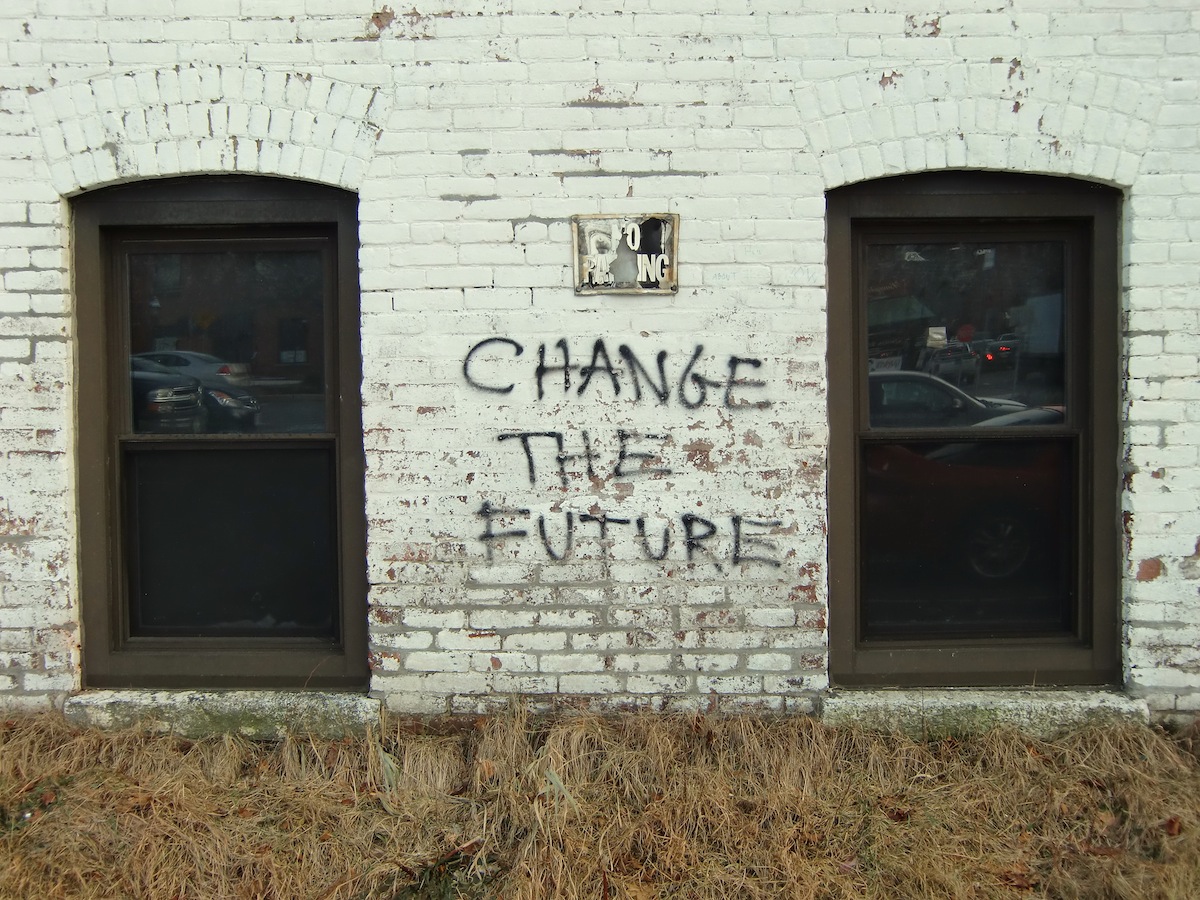
How to Change the Future — and Why We Need To!

I was recently sent a message from an old high-school friend:
I always see your posts and pictures, declaring war on capitalism, but what would the alternative be? Have you given it much thought? I understand your environmental concerns, but the point that I am making is: how would we continue to live the life which we are currently used to living, without capitalism? I am just uncertain as to your protestations. If there was one thing that you could change about the world, what would it be and how would you do it?
My response:

That's a complex and important question, which I'll do my best to answer, although you'll probably have to do your own thinking and come up with your own answers too. For myself, I have thought long and hard about it.

The short answer is, no, we cannot continue to live the life we are currently living. But we can live a good life, and the sooner we change, the better that life can be.

The long answer.

We currently are consuming non-renewable resources on this planet at a rapid, and increasing rate. Those resources, being non-renewable, are by their nature limited, and so our current way of life is also limited. Some have suggested that we would need 3 planets, or 7 planets, or whatever, to maintain our way of life, but even that is missing the point—our current way of life is unsustainable, and so it cannot, and will not, last.

When I say resources, I'm not just talking about rare-earth metals and oil, although both of those are limited. I'm talking about everything that we are using up: pristine forests and lumber supplies, fresh water and river health, ocean ecosystems and pH, atmospheric stability and CO2 levels, soil fertility and agricultural reliability, democratic capital, social services, labour resilience, etc., etc. The list goes on.

Our current trajectory, "business-as-usual", is using up those resources at an alarming rate. If it isn't curbed, it will result in at least a 6ºC global temperature rise by 2100, possibly much sooner. Governments around the world, supported by the best scientific data (as calculated by the worlds' most powerful supercomputers), have recognized that a 2ºC rise in global temperatures is 'dangerous' and to be avoided. Some scientists think that even 2ºC is too generous to allow ourselves. We're currently only at 0.7ºC rise, and we're already seeing superstorms, megadroughts, massive wildfires, 400,000 climate-change-related deaths per year, and a global reduction in GDP by 1.6%. So 400,000 people each year argue with their lives that even 0.7ºC is too much!

Given the risks of a 2ºC rise, the risks of a 6ºC rise are completely unacceptable: certain collapse of the global food production systems, with a resultant collapse of civilization: resource wars, cities left abandoned, starvation in the billions, a massive die-off of human beings. When every person is desperately searching for their next drink of fresh water and next meal, the last thing anyone will be worrying about would be continuing to "live the life which we are currently used to living". On this trajectory, the survival of the human species is put into question, and some predictions even question the possibility of the survival of multi-cellular life. But this is where we're heading.

I'll say again: this is where we are currently heading.

Obviously this is unacceptable. Therefore, we have to find another way of living on this planet that accepts the limitations of the world in which we live. We have to discover a way of living that respects and protects the systems that we rely on to survive.

Does this mean we should all retreat into peasant agriculture and indigenous forest-dwelling? No. I tried that myself, and I'm confident it won't work. Most of us have lost our ability to live in such a way, and most people would cling on to the current (suicidal) system before they give up their comforts anyway. So there has to be a different way. We have to face some difficult questions, and decide which of the current comforts we really want to protect, and which we'd be willing to give up.

An easy example of something we could give up is the waste usage of electricity that many applications use when they're not in use. Commonly called "vampire power", this accounts for ~10% of the electricity used in Western countries. To stop this, we simply need to make laws that prevent vampire power from being allowed. This would mean you would have to turn your TV manually, without the remote, but that's really not that bad. Electronics should also automatically turn off after a time (after a warning). This would prevent the TV-in-the-other-room being left on: it would automatically turn off after a certain amount of time, which could be stopped by a person actively telling it to stay on (this time, with the remote).

Another thing that will need to cease is the long-distance (un-walkable/cyclable) commute. I'm sure most people wouldn't miss it anyway, but stopping the commute requires a different kind of societal planning: integrated communities where people live close to where they work (and play), with electrified public transit for the exceptions. Every job that could be done from home online (probably 95% of office jobs) should be, and service companies that require a commute should have to pay dearly for it. All of this possible, it just requires some changes to laws and zoning, and more planning. Lots of planning.

People will need to eat less meat. They'll have to have less children. They'll have to repair things more, rather than replacing broken household objects. So things will have to be built so that they last, and so that they can be repaired. Currently, it benefits business to build things to become redundant, forcing us to buy a new phone/suit/car/TV every few years. Changing this will require legal changes, changes in resource-exploitation practices, and changes in the mentality of society. All of this is possible.

However, probably the most urgent switch we'll need to make is to change our energy (electricity) source away from carbon-releasing fossil-fuels (coal, oil, gas, fracking) to renewable and carbon-neutral sources (wind and solar seem to be the best options) as soon as possible. To avoid the 2ºC temperature rise, we can only emit 565 gigatonnes more CO2 (as of 2010). Between 2010-2012 we emitted 115Gt. At that rate we'll run out in just 12 years, or by 2025. The rate of consumption is still increasing. So in less than 12 years we'll have used up our entire quota of carbon dioxide emissions—if we continue on our current course. The sooner we change our electricity-production away from the outdated carbon-emission technology of burning fossil-fuels, the more leeway we'll have in other sectors, particularly agriculture and transportation. Those are the other two main contributors to carbon emissions. Transportation can be fairly easily be solved by switching to electrical, although doing so will require massive changes to our infrastructure (and legal structure). Due to emissions, biofuels/ethanol should be avoided, and new nuclear will take too long to come online (minimum 10 years), so these power sources are dead ends.

Agriculture also needs to be moved away from the carbon-intensive, soil-depleting, unsustainable industrial mono-cropping that relies on large amounts of fertilizer, pesticides, herbicides, and industrial machinery. Livestock is particularly bad for emissions, especially the horrific-yet-common practice of factory farming. Genetically-modified (GM) crops are also proving to be a dead-end, as they increase dependence on carbon-intensive practices like fertilizer and herbicide use. A lot more of us will need to become farmers.

A better world is possible, but we will need to have major societal change to get there. And we'll need to make it happen very, very soon. 12 years is very close. The sooner we start to make the changes, the better.

The world of de-regulated capitalism we live in today is not the only possible world, although the system would like you to believe that it is. But the fact is, we have created this system, decade-by-decade, removing regulation after regulation from polluters and abusers. The gross inequality in the world is no accident—it has been engineered by those seeking short-term profit. But just as we have built this system, we can—and must—unbuild it. We must re-regulate and equalize. We must reign in the abusers and stop the abuse. We must move away from the '1%ers' system of profit and inequality.

What is my one big wish? I want to see the end of ecocide. "Ecocide is the extensive damage to, destruction of or loss of ecosystem(s) of a given territory, whether by human agency or by other causes, to such an extent that peaceful enjoyment by the inhabitants of that territory has been or will be severely diminished." There is a growing movement to make ecocide illegal internationally by 2020. An international law against ecocide would prevent carbon-releasing projects like the Alberta Tar Sands (which contain 240gt of CO2—almost half of the total allowed, and by itself would result in a 1ºC rise!), as well as stopping the (ever-increasing) deforestation of the worlds carbon-sinks: forests. It would also impose a duty-of-care onto land-owners and corporations, which would trump the duty-to-profit, in the same way that today it is illegal to profit from genocide. It would turn "polluter pays (as little as they can get away with)" to "polluter doesn't pollute". In short, it would play a major part in changing the direction of our civilization, towards sustainability. But even this, world-changing though it may be, is just a piece of the puzzle. There are many, many other pieces that I have not mentioned here. This puzzle is the puzzle that we must work on every single day, not stopping until Mother Earth is at least able to tolerate us, and hopefully able to enjoy our species' existence once again.

I hope this helps. There are options, and we need to take them. And to do so, almost every single human being (yourself included) is going to have to become involved in making the change. Without you, we'll fail.

Cheers,
Stu


Wednesday, February 20, 2013

I quit the NDP


Dear Mr. Mulcair,

I'm writing today to let you know that I will no longer associate myself with the federal NDP, until the party takes a clear stand to oppose the existence and expansion of the Athabasca Tar Sands industrial complex, along with all the pipelines that would act as enablers for it (including Northern Gateway, Keystone XL and Line 9).

It will probably disappoint you to know that I was an NDP party activist, who dedicated his time to canvas heavily for the NDP during the previous federal (and Ontario provincial) elections, as well as additional volunteering. I would like to volunteer for the NDP again, but my conscious will not allow me to do so while the NDP party leader supports such a destructive project.

I am exceedingly disappointed with your decision (and it is your decision) to ally yourself with the most damaging industrial project on the planet. As James Hansen famously stated, this project will result in game over for the climate.

Many international agencies have been reporting on what this would mean, including (generally anti-environmental) economic and energy agencies such as the IMF and IEA. In case you haven't read the reports, I'll summarize them for you:

Game Over == The End of Civilization

Maybe it's worth pointing out the irony of the situation we're in: those who benefit the most from the status quo (the mega rich) are generally working to undermine it, whilst it's the environmentalists and indigenous peoples who are working the hardest to prevent the coming collapse. However, the coming collapse will be no laughing matter, as global food harvests would fail, resulting in famine on a scale that we've never seen before. It may have once been that environmentalists were seen to be idealists and those in business dealt with the 'real' world, but is now clear that it is the business world that is living in an idealism of limitless growth, and that it is environmentalists who are the ones with the strongest grip on reality. Indeed, with the consequences of climate change becoming clearer and more horrendous by the year, we cannot afford the dangerous fantasies of the business world any longer.

We have recently seen the coming to light of the Keystone Principle:
We must categorically cease making large, long-term capital investments in new fossil fuel infrastructure that “locks in” dangerous emission levels for many decades.
To support the Tar Sands in any way, including supporting pipeline construction (and reversal), is to actively work to destroy civilization as we know it.

Climate change is already responsible for 400,000 deaths each years and costs us $1.2tn/yr. Both of these numbers are set to double in the short term and increase by an order of magnitude in the mid term (if business-as-usual, and the tar sands continue). Therefore supporting the tars sands makes you directly culpable for genocide at an international scale. There will come a time when ecocide is considered to be an international crime against peace, and those who continue to support the tar sands would be taken to the ICC. I certainly hope you are not one of those people.

Not only are the tar sands environmentally suicidal, they are economically insane. They have already destroyed 500,000 (mainly NDP) jobs in manufacturing in Ontario, and are proving to be financially fragile and unstable. The tar sands put Canada at great risk, with only temporary and insignificant benefits. It is now cheaper is several countries of the world to produce energy using wind and solar technology. This is the direction our country should be heading. While we continue to invest in the tar sands, we are losing out on billions of dollars we could be getting from these sustainable energy sources.

Innovative wind and solar technology would provide Canada with a secure and stable economy, both in the short and long terms, and would provide tens of thousands more jobs. It's probably worth pointing out that the Keystone XL pipeline is estimated to only provide 50 permanent jobs (after the initial two years of construction are over). The oil industry is heavily automated, so it brings very little to the job-debate: far less than the renewable alternatives.

The tar sands are a dead end, with the emphasis on 'dead'. I call on you to condemn the tar sands, and to categorically reject its expansion, along with all of the pipelines that threaten the future health of Canada.

Yours sincerely,
Stuart Basden